The route

There is a common thread linking the stops along this route: your sense of wonder as you discover the many symbolic details that adorn the buildings, some of which are still waiting to be uncovered.

Travelling through the ages, we first discover that Pordenone could be described as the ‘city of astrology’: the signs of the zodiac can in fact be found in no fewer than three places, depicted in frescoes, paintings or sculptures. Strange figures and images, clinging to the walls of the houses in the ‘painted town’, seem almost to prop up the buildings themselves and will guide you to the ancient Mulino del Gobbo Pagotto.

Just a few more steps and you’ll come to a memorial dedicated to the fallen from all the institutions it represents, which holds, at its base, a small fragment of the Twin Towers in New York.

The route stops

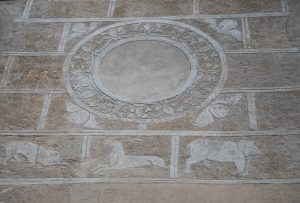
Restored in 2002, the palace features a façade decorated with lime stucco bas-reliefs displaying geometric motifs, vegetal friezes, and figures inspired by grotesque decorations. These are symbolic and somewhat mysterious images: dog, rooster, flint striker, deer, rabbit, dragon, piglet, sheep, winged putto, dog and fish, putto on dolphin.

At the center, you can read the owner's initials: "BM". This is the notary Benvenuto Marone, grandfather of Andrea Marone, the poet mentioned by Ludovico Ariosto (1474-1533) in "Orlando Furioso".

Detail of an exterior graffito on Palazzo Marone in Pordenone, depicting a geometric panel design: at the centre is a large circular medallion engraved with plant motifs and surrounded by cherub heads at the corners, whilst the lower section features animal silhouettes, including a deer and a wild boar, engraved into the mortar.

Dove si trova: Corso Vittorio Emanuele II, 31, 33170 Pordenone PN

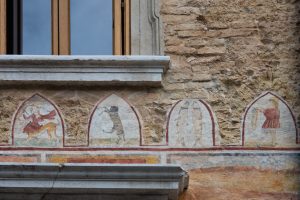
On Palazzo Marone-Da Ros, the painted sequence of zodiac signs is striking: it presents the full series of thirteen signs, matching the constellations of the modern zodiac.

Among these, Ophiuchus – or the Serpent-Bearer – stands out as the only one not considered a true astrological sign. Ophiuchus is situated between Scorpio and Sagittarius, south of the constellation Hercules. It is traditionally depicted as a giant holding a snake and represents the god of medicine and legendary physician Aesculapius (or Asclepius). You can spot him painted on our building: he’s the last figure on the right and depicts a man subduing a snake.

Another intriguing detail is the unusual sequence of the signs: Aries, Taurus, Cancer, Libra…

Detail of a fresco frieze painted beneath a stone cornice at Palazzo Marone in Pordenone. Four ogival panels separated by red frames follow one another on a rough-cast wall: the first depicts a female centaur with a bow and arrows, the second a climbing bear, the third two stylised figures of fish facing each other, and the fourth a human figure wearing a cap.

Dove si trova: Corso Vittorio Emanuele II, 31, 33170 Pordenone PN

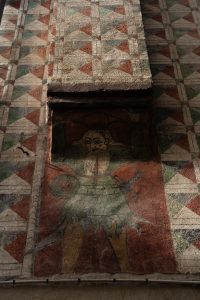
On the side wall of the so-called Casa dei Capitani, a painted figure of a warrior appears, serving as a support for the chimney flue — a telamon.

His identity remains unknown, but his blond beard, light eyes and the style of his headgear suggest the depiction of an Austrian soldier.
This is reinforced by the rich decoration of the façade, which features three large coats of arms: to the right, that of the San Daniele and Varmo family; to the left, the arms of the Austrian officer Baumkirchen; and at the centre, the colours of the House of Austria with the imperial eagle.

Detail of a frescoed interior wall in Palazzo Marone in Pordenone. In the centre, a bust of a medieval warrior is depicted wearing green scale armour, with a sword at his belt and a small circular shield. The warrior has a long blond beard and a fixed gaze. Above him, a section of wall featuring a geometric zigzag and diamond pattern rises like a column. The background is brick red and shows signs of wear, whilst a series of painted frames surrounds the fresco.

Dove si trova: Corso Vittorio Emanuele II, 45c, 33170 Pordenone PN

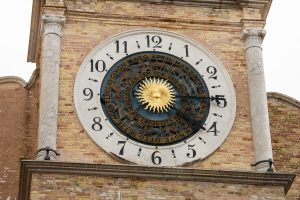
The original core of the Town Hall dates back to the late 14th century. A few years after Venice established a permanent presence there, in the mid-16th century, the clock tower was added. Although the internal mechanism has been replaced, the dial is still the original one, with a few minor alterations made in the 18th century.

The clock is not only a device for telling time, but a true compendium of astronomy: the dial shows the hours, the months and, above all, the signs of the zodiac; in the panel above, an aperture indicates the phases of the moon, gradually shifting from a starry sky to the smiling face of the moon.

A detail of an antique astronomical clock set against an exposed brick façade, flanked by two stone columns. The main dial features a traditional Roman numeral marking from 1 to 12. In the centre, a smaller rotating disc shows a radiant golden sun surrounded by a ring bearing the signs of the zodiac and the names of the months in archaic Italian, engraved along the circumference. The dark hands indicate the time, whilst the central mechanism illustrates the apparent motion of the celestial bodies.

Dove si trova: Corso Vittorio Emanuele II, 64, 33170 Pordenone PN

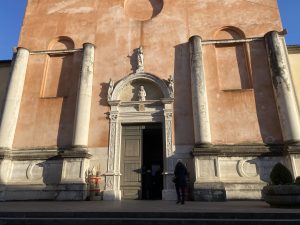
You are now standing in front of the Co-Cathedral of San Marco, better known as Pordenone Cathedral. Set into its façade – which was left unfinished following its 19th-century restoration – you can admire a Renaissance gem: the stone portal carved in 1511 by Giovanni Antonio Pilacorte (c. 1455–1531). The name of the sculptor, who was originally from Ticino but worked in Western Friuli, can be seen on the left-hand plinth of his own work.

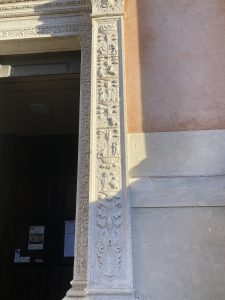
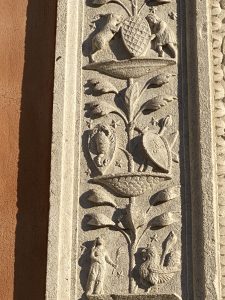
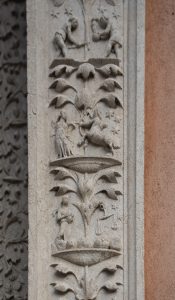
Carved into the door jambs – amidst foliage and decorative motifs – are the twelve signs of the zodiac: six on the right-hand jamb (Aries, Gemini, Leo, Libra, Sagittarius, Aquarius) and six on the left-hand jamb (Taurus, Cancer, Virgo, Scorpio, Capricorn, Pisces). On the faces of the bases are four reliefs depicting the Creation.

The façade of a historic church, characterised by pale pink plasterwork. The main entrance is framed by a carved stone portal, surmounted by a sculpted lunette depicting Christ, and crowned by a statue in an upper niche. Two large stone columns appear to support the central section of the façade, which features empty side niches. A person stands in the doorway, ready to enter. On either side of the portal are sculptural decorations and vases with plants. Sunlight casts sharp shadows on the structure, highlighting its architectural forms. Detail of a carved stone jamb from a monumental portal, richly decorated with Renaissance-style bas-reliefs featuring candelabra motifs. The decoration alternates plant motifs, such as vases and acanthus leaves, with small human and animal figures arranged in vertical panels. The light-coloured stone pillar contrasts with the adjacent antique pink wall, partially illuminated by side sunlight which enhances its three-dimensionality. To the left, one can glimpse the dark entrance to a sacred building with several notices posted on the door. A decorative stone relief featuring carved plant and animal motifs, set vertically on a façade. ‘A detail of a carved stone relief on a vertical pillar, divided into sections by stylised plant motifs. The carvings depict allegorical scenes or zodiac signs, including a centaur shooting an arrow (Sagittarius), a figure holding a set of scales (Libra) and other human figures, all set against a background of engraved stars.’

Dove si trova: Corso Vittorio Emanuele II, 55, 33170 Pordenone PN

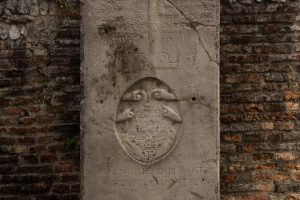
Along the boundary wall surrounding the rear of the Co-Cathedral of St Mark, there are several tombstones, which once lay on the church floor. Among these, one stone goes almost unnoticed, bearing blurred and worn inscriptions resulting from an attempt to reuse the slab. From the last owner, Mattio della Puppa, in 1726, we can trace back to previous owners thanks to close observation of minute clues, corroborated by in-depth studies. The first family to own the tombstone was that of the Pordenone scholar Pietro Capretto, alias Pietro Edo (1426–1504), who is regarded as one of the precursors of Italian melodrama.

The image shows a commemorative plaque or gravestone made of light-coloured stone, set between two red-brick walls. In the centre of the slab is a heraldic emblem carved in bas-relief within an oval shape, depicting stylised floral or animal motifs surmounted by a crown.

Dove si trova: Corso Vittorio Emanuele II, 55, 33170 Pordenone PN

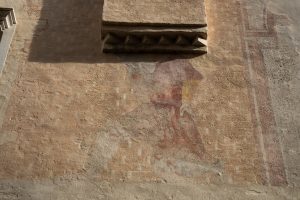
In Via del Campanile, in one of the city’s oldest corners, painted on the wall of a building, you encounter a man bent under the weight of a chimney.

The lintel bears the inscription “post tenebras spero lucem”, a passage taken from the Lamentations of Job (17:12): “noctem verterunt in diem, et rursum post tenebras spero lucem” (“They have turned night into day, and again, after darkness, I hope for light.”). It is a recurring phrase that conveys the idea of rebirth and hope.

On the same wall, over plaster painted to resemble brickwork, the coats of arms of the city and of the House of Austria are depicted.

The image shows an architectural detail of an ochre/beige plaster wall. Beneath a relief cornice featuring a series of triangular mouldings (with serrated edges), one can make out the remains of a faded fresco depicting a human figure, probably a saint or an allegorical figure, wearing reddish robes.

Dove si trova: Vicolo del Campanile, 33170 Pordenone PN

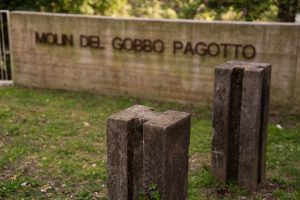
A series of curious small columns are all that remain of the ancient Mulin del Gobbo Pagotto, from which the street takes its name. These are the original supports of the sluice gates used to create the drop in water level (now gone) that powered the mill’s wheels.

This mill was one of the last in Pordenone to close (1968). In the past, production activities that relied on water power were widespread along the entire course of the canal.

The image shows an outdoor area, probably a park or a historic site, with a concrete backdrop to which the metal letters forming the name are affixed. In the foreground are two small rectangular stone or concrete pillars, each featuring a deep vertical slit running down the centre of each side.

Dove si trova: Vicolo del Molino, 33170, Pordenone

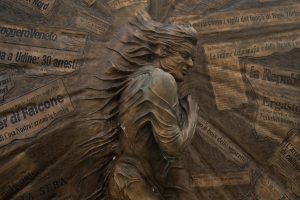
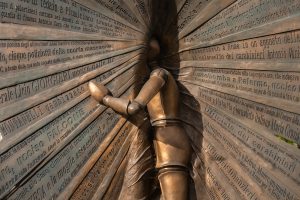
The monument is a bronze sculpture by the Perugian sculptor Fiorenzo Bacci (1940–2026), created in 2002. It is dedicated “to those who defend the safety and freedom of citizens, the law and our institutions, and who have been wounded, maimed or killed in the line of duty whilst serving their country”.

The work symbolises the human moral dilemma between good and evil: on the one hand, newspapers reporting attacks and deaths at the hands of criminals and terrorists; on the other, the successful operations carried out by the state’s security forces. At its base lies a fragment of steel from the Twin Towers in New York, donated by the New York Fire Department to the city of Pordenone.

The image shows a bronze sculpture featuring a central human figure in relief, whose features and clothing appear to merge in a dynamic movement. The background of the sculpture consists of numerous panels that faithfully reproduce the headlines and articles of Italian newspapers, transforming the surface into a sort of engraved historical archive.‘A bronze sculpture depicting a stylised human figure, resembling an articulated mannequin, positioned at the centre of a structure formed by metal panels radiating outwards. Each panel is covered with text engraved in relief, recounting dramatic events from recent Italian history, including terrorist attacks, Mafia murders and acts of political violence.’

Dove si trova: Piazzetta Giustiniano, 33170 Pordenone PN

Last updated: 13/06/2026 06:42

Gli altri percorsi

This site is registered on wpml.org as a development site. Switch to a production site key to remove this banner.