The route

Murals, monuments and frescoes bring to life, before your very eyes, lives that span the ages. They depict figures from Pordenone, some well-known, others less so: from medieval mothers who turned to the Virgin Mary to pray for milk or for their children’s healthy growth, to Friar Odorico, who set out from his hometown on an epic journey of fifty thousand kilometres.

Whilst the Counter-Reformation era brings to mind the bitter tale of Angioletta delle Rive, a victim of prejudice, this is counterbalanced by the marital affection between Sebastiano and Caterina, immortalised in stone.

It is a thread of memory that will take you right up to the present day, behind the scenes at the Teatro Verdi, where, amidst street art and poetry, Pordenone reveals the vibrant spirit of its inhabitants.

The route stops

In the 1970s, during works to refurbish the floor of the Duomo Concattedrale di San Marco, dozens of burials sealed by tombstones came to light. They date from the fifteenth to the eighteenth century, and each tells a story. Two deserve your attention.

The first is that of Simon Stocchetto, owner of a river transport service in Vallenoncello, the site of the customs office for the port of Pordenone. The chronicler Giovanni Battista Pomo, in his “Commentari urbani”, writes that in 1744 “he had a new and large barge built by the squeraroli buranelli” and that its launch was followed by a blessing from the parish priest and great celebrations. It was a flat-bottomed boat with a shallow draught, suitable for rivers and lagoons, and used for transporting people and goods and – in its most luxurious version – also for ceremonial purposes.

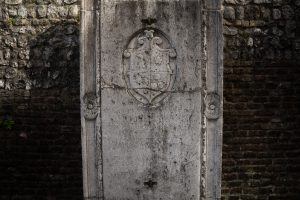
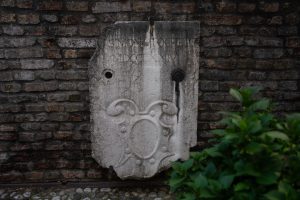
Another tombstone instead tells a story of deep conjugal affection. It bears two paired coats of arms: that of Sebastiano Mantica and that of Caterina Altan of Salvarolo. In a long inscription, the husband, who survived his wife, recalls the fifty-three happy years spent with her and the two sad and unhappy years of widowhood.

‘A detail of a light-coloured plaster façade, showing signs of wear, featuring a painted coat of arms between two windows. The coat of arms depicts a golden lion on a grey background in the upper section and red and white horizontal bands in the lower section. On either side are two windows with green wooden shutters that are visibly weathered.’ ‘An ancient stone slab set into a wall of bricks and rustic stone. In the centre, the slab features a coat of arms carved in relief at the top and a Latin inscription, partially worn away by time, which occupies the central section.’

Dove si trova: Vicolo del Lavatoio, 33170 Pordenone PN

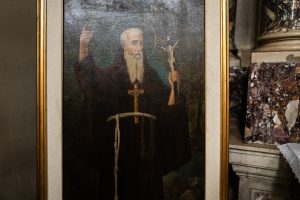
Enter the Duomo Concattedrale di San Marco and reach the altar of Saint Francis: here a small case holds the relic of the franciscan missionary Blessed Odorico of Pordenone (c. 1286–1331).

Born in Villanova, he took his vows at a very young age and, around 1318, set out on an extraordinary journey to the East that led him through Trebizond, Baghdad, India and Ceylon, as far as Canton and finally Beijing, then capital of the Mongol Empire. Here he was received by Emperor Yesün Temür Khan and remained for about three years.
His return was equally remarkable: he crossed Tibet — the first known European to enter Lhasa — and travelled thousands of kilometres across Central Asia and Persia. An itinerary of over 50,000 km at a time when travel was an extreme and uncertain experience. Back in Italy in 1330, he dictated his memories to the friar Guglielmo da Solagna: an account that conveys the true scale of an undertaking beyond the measure of its time, published posthumously under the title “De rebus incognitis”.

‘An oil painting depicting a bearded saint with a halo, wearing a dark habit typical of monastic orders, with a crucifix around his neck and a knotted cord around his waist. The figure holds his right hand aloft with his index finger pointing upwards and holds a small crucifix in his left hand. The painting is set in a gilded frame within a religious setting.’

Dove si trova: Piazza San Marco, 33170 Pordenone PN

On the building opposite the Church of Christ, a few fragments of frescoes reveal the former site of the city's first hospital. Starting from 1300, this location became a point of reference for pilgrims, travelers, orphans, and widows. Managed by the powerful lay brotherhood of the Battuti, the institution offered shelter and comfort to anyone in need.

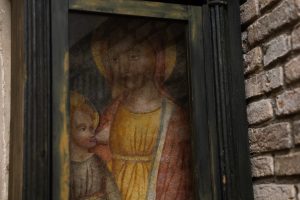
A further sign of the hospital’s presence can be seen at the corner of the same building: a small votive fresco of popular character depicting the Madonna del Latte. Women turned to this maternal image of the Virgin nursing Jesus to pray for an abundance of milk, protection during childbirth and support in the fragile period of the puerperium.

‘An ancient painting, probably a fresco, depicting the Virgin Mary nursing the infant Jesus (the “Madonna del Latte” motif). The work, characterised by warm colours, is protected by a glass panel and set within a dark wooden frame of austere design, all mounted on a rustic exposed brick wall.’

Dove si trova: Piazza del Cristo, 33170 Pordenone PN

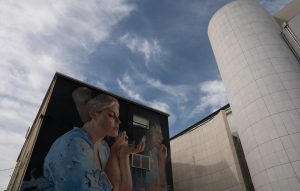
On the rear side of Teatro Verdi, opposite the artists’ entrance, the grey wall of the former SIP building hosts the work “Dietro le quinte” by Marta Lorenzon.

Created in 2021, the mural portrays Lisa Moras, artistic director of the local theatre company “Speak Easy”, as she applies her make-up before going on stage. Completing this backstage scene, you can also notice another actor from the company in the background preparing for the performance. At the bottom, the cranes emerging from the actress’s dressing gown and the deliberately blurred areas created by the artist will stimulate your imagination.

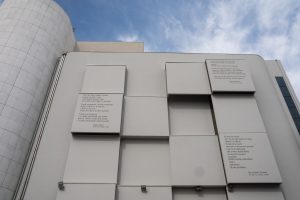
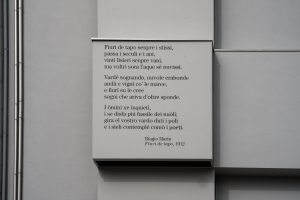
In Piazzetta Pescheria, the rear façade of the theatre has also been enriched with large-scale verses, including those from “Fiuri de tapo” by Biagio Marin (1891–1985), “Canzoniere” by Umberto Saba (1883–1957) and “Io non ho mani“ by David Maria Turoldo (1916–1992). This is the so-called “Piazzetta dei Poeti”, a project born from the collaboration between Teatro Verdi, Fondazione Pordenonelegge and the Municipality of Pordenone.

‘A modern, minimalist façade of a light-coloured building, characterised by a series of protruding geometric volumes in the shape of parallelepipeds. Poems in Italian are engraved on three of these panels. On the left-hand side, part of a modern cylindrical structure clad in white tiles is visible, all set against a blue sky with a few clouds.’ ‘A detail of a rectangular grey architectural panel protruding from a modern wall with a minimalist design. A poem in dialect is printed in black on the panel, with the attribution “Biagio Marin, Fiuri de tapo, 1912” at the bottom. To the left of the panel, two metal tubes run vertically along the surface of the wall.’

Dove si trova: Piazzetta Pescheria, 33170 Pordenone PN

Angioletta delle Rive lived in Pordenone between 1580 and 1650; she and her daughter Giustina were accused of witchcraft. Accused of practising witchcraft and causing the death of a woman, she was imprisoned by the Inquisition tribunal in Udine, where she died in January 1651, before her trial.

The truth is that Angioletta was a penniless widow who scraped by as best she could: she practised herbal medicine and assisted with childbirth in the homes of the local nobility; in short, a poor jack-of-all-trades who was the victim of gossip, rumours and slander. Only her daughter, after her mother’s death, was spared on condition that she promised to ‘live as a good Christian, neither practising medicine nor casting spells as my mother did’. This is a true and well-documented story, based on the preliminary investigation files held in Venice and recounted in Ornella Lazzaro’s book *Le amare erbe*.

Today, a stele in Angioletta’s honour commemorates the injustices she suffered: created by the sculptor Gianni Pignat in 2009, it stands in the place where she once lived, which now often hosts events linked to 8 March, International Women’s Day.
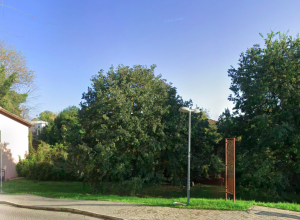
‘An exterior view of a green space with a paved path in the foreground. In the centre lies a lawn with dense trees, flanked by a modern street lamp and a slender, rust-coloured vertical metal structure. To the left, the corner of a building is visible, all set against a clear blue sky.’

Dove si trova: Vicolo del Molino, 33170 Pordenone PN
Last updated: 13/06/2026 06:41

Gli altri percorsi

This site is registered on wpml.org as a development site. Switch to a production site key to remove this banner.